Southwark Jail
The Man Who LaughsSouthwark Jail is the prison that receives Gwynplaine after his arrest, a place whose ancient, forbidding architecture turns the loss of liberty into a visible threshold. Its heavy door swallows him from view, and the novel measures the speed of his reversal by setting that entrance against his arrival at the House of Lords only thirty-six hours later.
Setting and History
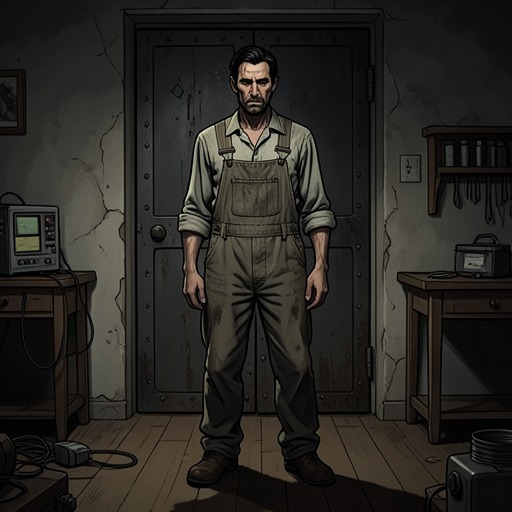
The prison’s lower door is a heavy construction of oak and iron. When it opens, the dark beyond appears like a cavernous mouth; after Gwynplaine passes inside, the wicket closes and the door settles against its stone sills. The bolts seem to slide back into place by themselves, leaving no visible doorkeeper. The mechanism makes entry feel less like crossing into an institution than being sealed inside a tomb.
The building’s history carries the same weight of accumulated power. It began as a pagan temple built by the Catieuchlans for the Mogons, became a palace for Ethelwolf and a fortress for Edward the Confessor, and was made a prison by John Lackland in 1199. Once intersected by a street and serving as a gate to the suburb, its passage was eventually walled up. The account places it among other old English prisons that originated as gates, including Newgate, Westgate, and Canongate; the Bastille in France is offered as a comparable example.
Gwynplaine’s Imprisonment
Gwynplaine disappears through the prison’s entrance while Ursus watches. The sheriff’s officer has identified the arrest as being by order of the Queen, and the closing door turns that command into an immediate fact: Gwynplaine is removed from the world outside before he can explain himself or return to his performance.
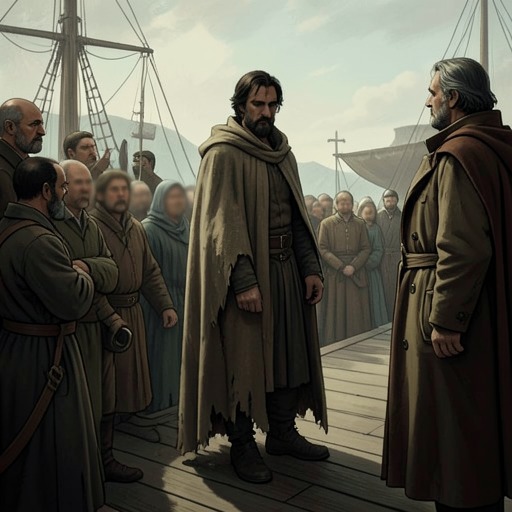
Inside, Gwynplaine insists that he does not know the man whose recognition has brought him before the authorities. He asks for his liberty, asserts his innocence, and describes himself as a travelling mountebank who has earned an honest living for fifteen years. The sheriff answers by addressing him as Lord Fermain Clancharlie, Baron Clancharlie and Hunkerville, Marquis of Corleone in Sicily, and a peer of England. He rises and offers Gwynplaine his chair. The prison is thus the setting for a sudden collision between the identity Gwynplaine claims and the noble status the authorities impose upon him.
Threshold and Reversal
The novel later measures the interval between Southwark Jail and the House of Lords: only thirty-six hours have elapsed since Gwynplaine entered the prison’s iron door. The contrast is stark. A man who had been shut away behind a gate that closes like a tomb is now approaching the gilded door of the Lords, with the events in between described as a rapid assault of hard facts upon his mind.
Southwark Jail therefore stands at the hinge of Gwynplaine’s abrupt change in status. Its architecture embodies confinement and institutional force, while its place in the sequence makes the prison a threshold between his life as a travelling performer and his recognition as a peer. The passage from its iron entrance to the Lords’ gilded door compresses that upheaval into a contrast between two doors and two forms of power.